


We are quickly approaching 2027, which means privacy and Security training Season is around the corner. All users are required to complete Alameda Privacy and Security Training within the timeframe of January 1st - February 28th 2027. Once you have completed the training, please notify your Agency Liaison. Agency Liaisons will be notified of users who still have not completed the training. For users who have not completed the training by the deadline, the account will be made inactive, and the training will need to be completed to reinstate the users' account.
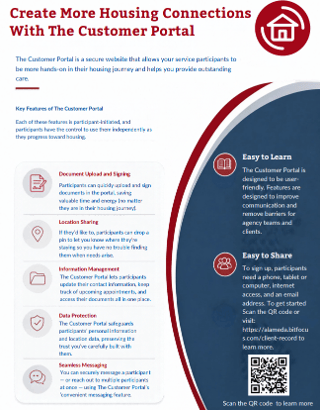
Have you ever encountered a situation where you needed to communicate an update to a client or obtain housing documents from them, but they were unable to visit you in person? The Customer Portal is designed to address such challenges.
The Customer Portal supports:
• Document Upload and Signing
• Location Sharing
• Contact Information Updates
• Appointment Management
• Sending & Receiving Messages
• Program Enrollment History
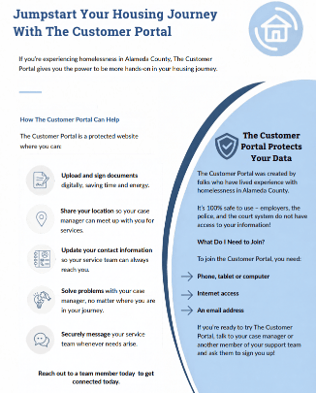
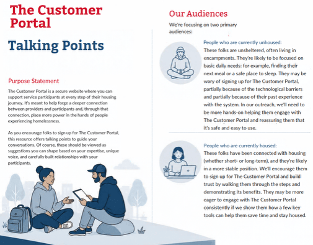
The Customer Portal is designed to be user-friendly, with features that enhance communication and eliminate barriers for agency teams and clients. Each feature is participant-initiated, allowing individuals to use them independently as they progress toward housing. Additionally, the Customer Portal prioritizes participant privacy and security, safeguarding their personal information and location data to maintain the trust you’ve built with them. To support the sharing of this valuable community resource, we’ve developed Customer Portal tools, including Talking Points and Fact Sheets, for both users and clients.
User Fact Sheet Client Fact Sheet
 .
The Customer Portal Talking Points

The 2026 federal reporting season has officially begun. Our team has kicked off data outreach and analysis for two critical HUD Continuum of Care (CoC) reports: the Longitudinal Systems Analysis (LSA) and System Performance Measures (SPM).
Because LSA data serves as the foundation for the SPMs, cleaning up your data during the LSA process directly improves our community’s System Performance Measures.
In last month’s newsletter we shared details about reports you can run to ensure your data is accurate. Over the coming weeks, the Bitfocus team may contact you to review, verify, or update program- and client-level data. You can support this effort by:
Thank you for your ongoing commitment to maintaining timely, complete, and accurate data across our community!
 With LSA season under way, this report shows how complete your data is across your whole system, before HUD does. It uses the same data quality tables as the APR, CAPER, and CE APR, so data quality issues here will match what you see in those federal reports. The report covers:
It also flags invalid SSNs, such as 123456789 or any number starting with 000, 666, or 900-series digits.
How it connects to the LSA. The tables match several elements that HUD checks when it flags your LSA data. Each one has a threshold, and going over it triggers a flag:
| LSA Element | Flag Threshold | Where to look in HUDX-225 |
| Race and Ethnicity | More than 1% missing | Q2, Personally Identifiable Information |
| Disabling Condition | More than 10% missing | Q3, Universal Data Elements |
| Exit Destination | More than 5% missing | Q4, Income and Housing |
HUDX-225 does not cover Prior Living Situation "Type of Residence" or Survivor of Domestic Violence. For those two, use the [GNRL-220] Program Details Report or the Federal Report Data Cleanup Assistance dashboard.
What counts as missing. HUDX-225 counts a response as missing when it is "Data not collected," blank, or when the whole record is absent. The LSA counts more answers for some elements:
Open the drilldown for those elements and check those answers too. An LSA flag can also appear when nothing is missing. This happens if an enrollment falls outside the program's operation dates or HMIS participation dates, or if a night-by-night shelter's start or exit date differs from its first or last bed night.
Why this matters: HUD sets thresholds for the percentage of missing data across a CoC's whole system. A CoC that exceeds them gets flagged, and high levels of missing data affect how usable the community's LSA data is. Every blank or "data not collected" answer you fix now helps your whole community.
Want more information? Check out our Help Center Article.
2026 Alameda County Point-in- Time Count Data
What is the Point-in-Time Count?
Every two years, the US Department of Housing and Urban Development (HUD) requires communities to conduct a Point-in-Time (PIT) Count of individuals, youth, and families experiencing homelessness and to provide specific data about their demographics and characteristics. The count includes those who are forced to sleep outdoors, in vehicles, tents, or makeshift structures, as well as a count of people residing in shelters, transitional housing, and safe parking programs.
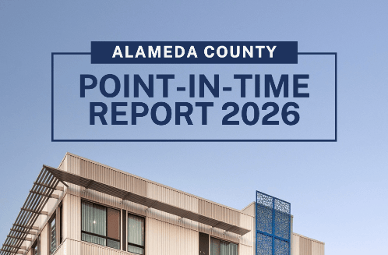
2026 Homeless Point-in-Time Count Report
On Thursday, January 21, 2026, early in the morning, more than 1,300 volunteers gathered across the county to conduct the 2026 PIT Count. This month, we’re sharing the full 2026 Point-in-Time Count Report. The report includes PIT survey results, client demographics, subpopulations, and city-level data. Clarity users are encouraged to review these results for a full view of homelessness in Alameda County.

Make sure you don’t miss out on any of the wonderful events hosted by Alameda County HMIS at Bitfocus! You will see demos, learn about what’s new, and hear announcements for what’s to come! These events are for anyone who would like to join. Please make sure to register in advance. Just a friendly reminder: October’s User and Liaison Meeting was our final meeting of 2026. We will see you in January!
Alameda HMIS Q&A Session
2nd Tuesday of the month @ 10:00 am
Register | HERE
Alameda Users and Liaisons Group Meeting
4th Tuesday of the month. Meetings are paused for November and December
User Group Meeting: 10:00 am – 11:00 am
Liaison Group Meeting: 11:00 am – 12:00 pm
Register | HERE

© 2003-2026 Bitfocus, Inc | All Rights Reserved